
A Step-by-Step, Real-World Guide to Securing Company-to-Company API Communication Using OAuth 2.0
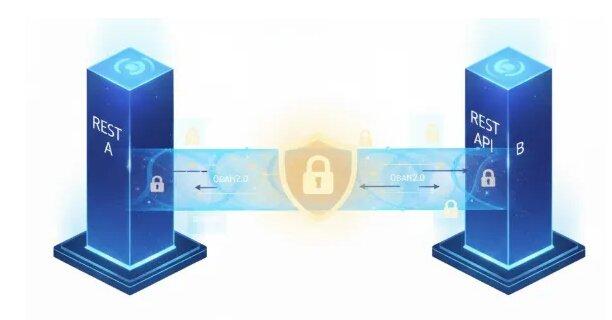
Most system-to-system integrations still lean on shared API keys or long-lived secrets tucked into config files — simple, but a permanent liability: no expiry, no rotation, no granular control. I wrote up a full walkthrough of replacing that with OAuth 2.0's Client Credentials grant, using two independent Spring Boot services — Company A and Company B — that each issue their own tokens and validate each other's. This is the short version; the full article on Medium has the complete Spring configuration and working source code.
Two Companies, Two Authorization Servers
The rule that avoids a mess of circular trust: the caller always requests a token from its own Authorization Server, never from the partner's. Company A issues tokens and protects /api/articles; Company B issues its own tokens and protects /api/employees. Each side acts as OAuth Client, Resource Server, and — for its own domain — Authorization Server at once, with scopes like articles.read and employees.read enforcing least privilege instead of blanket access.
Where It Actually Bites You
- Scope mismatches — a token minted with
articles.readhitting an endpoint that expectsemployees.readfails with a silent 403, even though the signature checks out fine. - Wrong issuer trust — validating tokens from anyone other than your own Authorization Server breaks the whole model.
- Skipped JWT validation — signature and audience checks have to be explicit, or valid tokens get rejected too.
- Blurred roles — client, resource server, and token issuer are three different jobs; mixing them up in configuration is where most of the real-world debugging time goes.
The full write-up walks through the Spring Authorization Server setup, the RestClient interceptor that attaches tokens automatically to outbound calls, and the exact 403 trap most teams hit on their first attempt — plus the complete working source code. Continue reading: the full article on Medium →

Mohammed Ahmadi
Software Developer
Recommended
- JBang: Turning Java Into a Scripting Language
- Resilience4j in Spring Boot: From Zero to Production-Ready Fault Tolerance
- End-to-End Testing with Playwright — Quick Setup & Best Practices
- Visualizing SBOMs with the Dependency Radar: A Practical Approach to Dependency Management
- Request-Response API Styles: REST vs gRPC vs GraphQL vs SOAP
- Building a 3D Warehouse Visualizer with Three.js
- Do We Really Need an LLM for Every Decision? Testing Jev with Spring Boot